Exhibitions

Forgotten Island. Colección CGAC
Forgotten Island plantea una reflexión sobre la creación
...
Manolo Laguillo. Galicia urbana
The documentation and interpretation of the territory through different gazes, materialisations and approaches has been one of the CGAC's constant lines of work throughout
...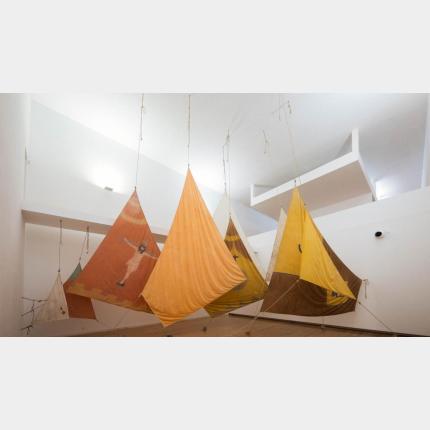
JANNIS KOUNELLIS. Labyrinth without Walls
"Jannis Kounellis.
...
Alexandra Ranner. Rumor
The Berlin-based artist Alexandra Ranner (Osterhofen, Germany, 1967) is to present her first solo exhibition in a Spanish museum at the CGAC.
...
Misha Bies Golas
Back in the mid-nineteen nineties, a young Misha Bies Golas (Lalín, Pontevedra, 1977) discovered the CGAC out of a sort of impulse and curiosity for the institution that ha
...
LLUÍS HORTALÀ. BEFORE THE LAW
Lluís Hortalà (Olot, Girona, 1959) plays with the deception and confusion of the gaze, immersing us in the art of trompe l 'oeil.
...
Internalities
Architectures for Territorial Equilibrium. Spanish Pavilion, Venice Architecture Biennale 2025
The CGAC, the first museum designed by Álvaro Siza Vieira, has addressed architecture from multiple perspectives throughout its programme of activities and exhibitions, oft
...
Perception and uncertainty
In 1999, the CGAC, under the direction of Miguel Fernández-Cid and in partnership with the Escuela Internacional de Teoría en las Humanidades of the Universidade de Santiag
...
Carlos Pazos. Nicasso
"Nicasso" is a work by Carlos Pazos (Barcelona, 1949) executed in 2006 and purchased shortly after by the CGAC to be included in "The Shadow of History", an exhibition focu
...
Territory
Video Art from Central America
"Territory" is the first monographic exhibition on video art and video performance from Central America to be held in Spain.
...
Archiving to care (for ourselves and for each other)
Shared Outcomes of the Workshop 'O Forno da Amara'
One photograph. Two. Thirty-three. Two hundred and twenty-four. They arrive from all directions. Front doors open, biscuit-tin lids lift, family albums unfold.
...
Priscilla Monge. Matters of life or death
Priscilla Monge’s work has often been included in the post-conceptual scene of Latin America in the nineteen-nineties, but it should be borne in mind that during that time
...